
Plenary Speakers
Tuesday, November 13
Plenary Talk 1 9:20-10:05 Room 301
Expectations for the Semiconductor Technologies in EVs and HVs
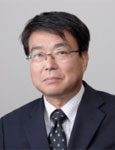
Dr. Shoichi Sasaki
Prof., Keio Univ., Japan
Abstract
EVs and HVs will have a certain share in the future market place.
To populate these vehicles, the semiconductor technologies will play a central role. And those technologies will be crucial for the quality of EVs and HVs.
As for the near term items, for example, the size and loss of inverter used in EVs and HVs are important because of its cost and electrical "fuel " consumption.
To populate EV and HVs, cost will be the most crucial factor even in the future.
The portion of battery cost will still be large compared to inverter and motor cost. Therefore there is a need of cutting the cost of batteries for EVs and HVs.
To do so, there are some technologies undergoing. One is to redesign the circuit topology of traction motor system which can utilize the relatively inexpensive battery cells.
And the other is to transmit the electrical energy from road to the vehicle without contact.
These technologies are presented and expectations for the semiconductor technologies are explained.
Biography
He was born in 1949. He graduated from the University of Tokyo, and has B.S and M.S. degree (Electrical Engineering). He joined Toyota Motor corp., and was mainly involved in the development of Electric and Hybrid vehicles.
His main research field was the application of power electronics to the vehicle.
Through the contribution of the development of the Toyota Prius, and the related inventions, he was received the award of Ministry of Economy, Trade and Industry from the Japan Institute of Invention and Innovation (2004), and also received the Technical Award from The Japan Society of Mechanical Engineers (1998), IEEE 2010 Daniel E. Noble Award, IEEE 2011 Medal for Environmental and Safety Technologies.
He is now interested in the system design for the advanced technology vehicles and systems.
He is now the professor of Keio University Graduate School of System design and management.
Plenary Talk 2 10:05-10:50 Room 301
Semiconductor Memory Scaling and Beyond
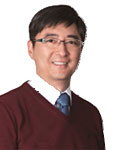
Dr. Sungjoo Hong
Senior VP, Head of R&D Division, SK hynix Inc., Korea
Abstract
Semiconductor is an indispensable component of modern electronic systems.
The history of the semiconductor industry is namely the history of scaling, represented by the Moore's Law describing that the number of transistors incorporated in a chip approximately doubles every 18 months, and the semiconductor industry has pursued the rule in practice. The semiconductor memory industry has even accelerated much faster scaling than the others, introducing doubling density almost every year, and which has consequently benefited consumers by advancing the mobile era.
Two decades ago, the first storage product using Flash memory was 2MB in density, priced at $50/MB, but we are enjoying 128GB with $1/GB today, and which is due to rapid scaling.
Besides, every semiconductor memory company is facing the ultimate physical limit of scaling.
Development of 1xnm technology for memory products requires controlling of 16 critical electrons for NAND Flash and an aspect ratio of capacitor of higher than 60 for DRAM.
Natural question arising here is "What will be the next?". As part of efforts to overcome those limits and grasp new opportunities, the paper will report on new memory technologies such as STT-RAM, ReRAM, and PCRAM, which are expected to meet such specifications as high density, low power, and high speed that the mobile era requires simultaneously.
Biography
Sungjoo Hong received BS in Physics at the Seoul National University (SNU) in 1985 and obtained MS and Ph.D. degree in Physics at the Korea Advanced Institute of Science Technology (KAIST) in 1987 and 1992, respectively.
Then, he joined Hyundai Electronics Industries Co., Ltd in 1992 and the company had been renamed as Hynix Semiconductor Inc. (Currently SK hynix Inc.) in 2001.
He became the head of Device and Process Integration Group of R&D division of Hynix Semiconductor Inc. in 2004.
During his term of the head of the Device and Process Integration Group, he received the Korean Semiconductor Technology award (a Presidential citation) in 2006 for successful development of 512Mb DDR2 DRAM with 80nm that provided the world longest retention time performance and outstanding yield rate.In April of 2010, he was appointed as the head of R&D division of Hynix Semiconductor, now being in charge of the research and development of DRAM, NAND Flash, and new memory technologies such as Phase Change Memory, Spin-Transfer-Torque Memory and Resistance Memory.
Additionally, he served as a member of JFE Technology Program Committee in the 2012 IEEE Symposium on VLSI Technology and Circuits.
Wednesday, November 14
Plenary Talk 3 9:00-9:45 Room 301
Integrated Circuits and Systems toward Smart Ubiquitous Patient-Centered Medical Environment
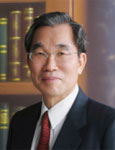
Dr. Ming-Fong Chen
Superintendent, National Taiwan University Hospital, Taiwan
Abstract
Integrated circuits and systems have emerged to play a critical role in supporting the patient-centered medical home (PCMH) model of health care delivery. PCMH model of care has been performed in National Taiwan University Hospital (NTUH), Taiwan. The wireless ECG monitoring devices capable of measuring nonlinear heart rate variability and providing GPS localization information help the cardiologists to better handle the emergency condition of heart failure. A multi-modal signaling processor has been integrated to address patient with acute coronary syndrome, ischemic stroke and subarachnoid hemorrhage and facilitate early detection of targeted events. Electro-sensing antibody probing system has also been realized for biomedical samples. The service package of Telecare center of NTUH is composed of synchronous transmission of biometrics, mutual telephone communication, and rapid decision-making support. By integrating the bio-medical MEMS sensors with silicon circuits into mobile phones, physiological signals and vital signs can be monitored at any place and any time. With the mobile phone as a personal medical information hub, the biometrics can be sent to cloud for real-time monitoring and further analysis.
Biography
Ming-Fong Chen obtained MD and PhD degrees in College of Medicine, National Taiwan University (NTU), Taipei, Taiwan in 1975 and 1990, respectively.
He also obtained EMBA degree in College of Management, NTU in 2002.
He completed his medical resident and cardiologist training at Department of Internal Medicine, NTU Hospital from 1977 to 1981.
He also received research fellowship in Department of Physiology and Biophysics at Georgetown University Medical Center, Washington, USA from 1991 to 1992.
He got instructor, associate professor and professor of Internal Medicine at College of Medicine, NTU in 1989, 1990, and 1995, respectively.
He became vice-superintendent, chief of Department of Internal Medicine and superintendent of NTU hospital in 2002, 2007 and 2008, respectively.
He is fellow/member of many international societies (FACC, FESC, FACP etc).
He also published many papers in world famous journals.
Plenary Talk 4 9:45-10:30 Room 301
Technology Challenges and Opportunities for Ubiquitous Computing
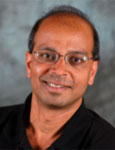
Dr. Shekhar Borkar
Intel Fellow, Intel Corp. U.S.A
Abstract
Unprecedented transistor integration capacity will be available to make computing truly ubiquitous, but the energy consumption will be a major challenge. Compute energy can be reduced by employing near threshold voltage operation. However, data movement energy will become prohibitive. Software will have to be cognizant of data locality, with introspection for fine grain energy management. The entire stack has to participate in implementing resiliency. Such a holistic system approach will make computing truly ubiquitous.
Biography
Shekhar Borkar is an Intel Fellow, an IEEE Fellow, and Director of Extreme-scale technologies at Intel Corporation. Shekhar has been with Intel since 1981, worked on the 8051 family of microcontrollers, supercomputers, high performance, low power digital circuits research, and served as the principal investigator of the DARPA funded UHPC project. He has authored 83 peer reviewed publications in conferences, 31 papers in journals, 56 invited papers and keynotes, four book chapters, and has more than 50 patents issued. Shekhar served as the TPC chairman of VLSI Circuit Symposium in 2002, and as the conference chairman in 2004. Shekhar was an adjunct faculty at Oregon Graduate Institute, taught graduate course on VLSI design for more than 10 years. His research interests are low power, high performance digital circuits, high speed signaling, and system level optimization. Shekhar holds M.Sc. in Physics from University of Bombay in 1979, and MSEE from University of Notre Dame in 1981.